Apertus 1.5: a Swiss AI model with an expanded context and high-performance vision, a lever for SMEs
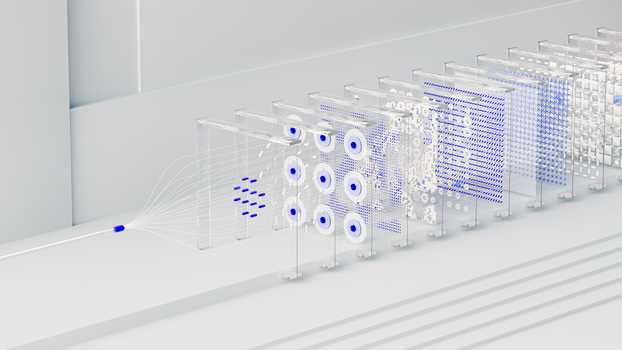
Artificial intelligence takes another step forward with the launch of’Apertus.ai version 1.5. This major update introduces a extended context and the native image comprehension, This makes the model significantly more efficient for complex use cases. In this article, we break down the training phases that enabled this evolution, as well as the results obtained, to measure their concrete impact on companies' digital tools.
A broader context and a redesigned artificial vision
The main advancement of Apertus 1.5 lies in the massive expansion of its context window, now capable of processing up to 128,000 tokens in a single query. This capability relies on a profound modification of the attention mechanism, where the positioning matrices have been retrained to avoid performance degradation on long segments. In practical terms, the model can analyze an entire legal document, a maintenance history, or a technical manual without losing track of information presented several pages earlier.
The other pillar of this version is multimodal understanding. The training has been broken down into three main stages. First, a massive pre-workout on a corpus combining captioned text-image pairs and long text documents, in order to anchor semantic representations. Then, a phase of supervised fine-tuning exposed the model to visual analysis tasks: describing images, extracting information from screenshots, and recognizing patterns or graphs. Finally, a alignment through reinforcement learning (RLHF) made it possible to refine the quality and accuracy of the responses, minimizing visual hallucinations.
The unique feature of the Apertus 1.5 pipeline is its use of a partially frozen visual encoder coupled with a trainable projector, which reduces computational cost while maintaining high-quality interpretation. Thus, the model does more than simply "see" an image: it can compare it with text, extract inconsistencies, and even generate step-by-step instructions from a technical diagram. This approach makes it much more relevant for sectors such as logistics, manufacturing, and customer support, where visual documents are ubiquitous.
Measurable performance and opportunities for SMEs
The results published on the official Apertus.ai article They show significant improvement in several benchmarks. For tasks involving understanding long contexts, the recall score in the middle and end of documents increases by 22 (%) compared to the previous version, thus preventing the loss of critical information. Regarding image comprehension, the model achieves accuracy comparable to systems specializing in the recognition of invoices, software interface screenshots, or product sheets. In parallel, the hallucination rate has been reduced by 18 (%), an indicator that reassures companies wishing to automate processes with a high level of reliability.
These capabilities are not merely theoretical; they open up immediate applications for small and medium-sized businesses. Imagine an assistant capable of reading a handwritten order form, comparing prices with an online catalog, and generating a personalized quote based on the customer's entire history. To transform this advancement into an in-house solution, SMEs need a robust technical environment. This is precisely where Oxegena's expertise comes in., a digital agency specializing in AI integration for small businesses and an application hosting service provider.
By leveraging well-designed APIs and optimized containers, an SME can integrate the functionalities of Apertus 1.5 into its ticket management system, CRM tool or document portal.
Conclusion
Version 1.5 of Apertus.ai marks a significant advancement by combining a very large context with reliable computer vision, validated by strong results in relevance and error reduction. The training stages—from multimodal pre-training to fine alignment—demonstrate that these capabilities are now mature.
Apertus.ai version 2.0 is planned for late 2026 – This version aims for better performance in programming, mathematics and integrates advanced agentic functions.